
Mukund / Abhimanyu Bhai / Heera Singh, Chitrakoot Aapda Adhyayan Kendra
Tulsidas wrote in the Ramcharitmanas: “Hari Ananta Hari Katha Ananta.” If he were alive today, he would say the same of this place: Chitrakoot anant Chitrakoot katha anantaah. And the story that sums it all up is the tale of a confluence where only tears flow now.
From the lap of Kamadgiri, one of the Vindhya peaks, once rose three rivers like three sisters — Mandakini, Payaswini and Saryu. They met near Raghava-Prayag, joining hands in a single holy union. Payaswini’s water was white as milk — people still believe that in the Treta Yuga, milk itself flowed in it. On these banks, Lord Rama offered the funeral rites for his father, King Dasaratha, and spent eleven and a half years of his exile. That faith is still alive in the soil of Bundelkhand.
They say never let such faith die, for faith is the blood that runs through rivers themselves. But over the past sixty years, that faith has been choked — slowly, quietly, ruthlessly. Land mafia grabbed the riverbeds. Hotels and ashrams rose on them. Untreated sewage poured into that very stream of “milk.” And concrete sealed the mouths of the river’s springs, one by one.
Walk down to Raghava-Prayag today and you will still find the ghat. But you will not find Saryu. You will not find Payaswini. In their place, two filthy drains open into Mandakini, carrying half the filth of the pilgrim town. Mandakini — the river on whose banks Tulsidas composed the Ramcharitmanas — has itself begun to run black.
A river that once washed away sins is now bathed in filth. A river that promised liberation now carries the sewage of the town. And when someone raised a question, the answer for years was just a map — demarcation lines drawn on paper.
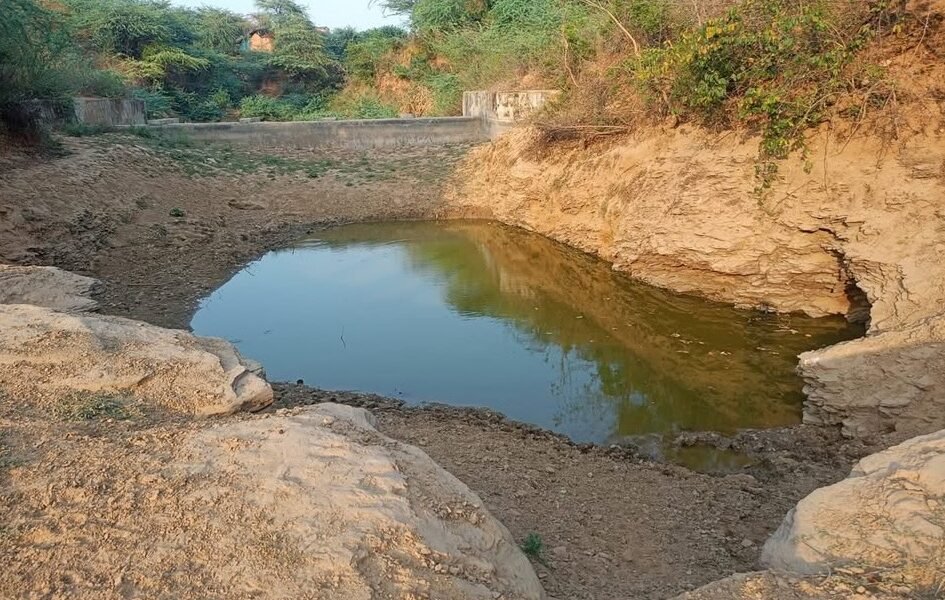
Then, in March 2022, the administration dug at Brahmakund, where Payaswini is born. Ten feet down, a water source burst open. The river was never dead. She was only waiting — waiting in silence for someone to take her hand. The stream of milk is still alive under the earth.
She asks for three things only: clear the encroachments, cleanse the drains, dig out the springs.
The Brihad Ramayana of Maharshi Valmiki, in its Chitrakoot section, tells of this river rising from Brahmakund south of Kamadgiri, flowing past the Santoshi and Nirmohi akharas, and merging with Mandakini at Raghava-Prayag — a course of barely three kilometres. Today that name, Payaswini, has shrunk to a drain the records call Pishuni or Peshwani. The river described in the Srimad Bhagavatam — the very ‘pay’ (water) of the verse “lakhan dheekh pay utar karara”, which some commentators identify with none other than Payaswini, the stream of milk — is today written into revenue records as no more than a drain.
Saryu rose as a stream on the eastern flank of Kamadgiri and met Mandakini alongside Payaswini. Hers is the same sacred name Tulsidas made immortal in “avadha puri mama puri suhavani, uttar disa baha saraju pavani” (beautiful is my city Avadhapuri, in the north flows the holy Saryu). The Saryu of Ayodhya and the Saryu of Chitrakoot are different rivers, yet here too she held the same place in people’s hearts.
Today that stream has dried up. In hearings before the National Green Tribunal, the Saryu-drain matters only as a “divider” on the boundary between Madhya Pradesh and Uttar Pradesh — a dry gully that carries water for a few days of the rains and is bone dry a day or two after.
The NGT’s orders of 2015 and 2021 record what the water looked like: at Ramghat, Payaswini and Saryu ran black and brown. Through these “drains” flows the whole reckoning of Chitrakoot — the town’s sewage, the rubble of its monasteries and temples, the spill of every hotel and restaurant. A few pilgrims still believe that to die in Chitrakoot is to be liberated. But in the very water where their ashes are immersed after death, even fish cannot live.
If we wish it, one day the three sisters will meet again at Raghava-Prayag. And that day the three of them will weep — with joy.
Until then, remember one thing: a river truly dies the day we stop remembering her. We still remember Payaswini. And that is why she is still alive.
Water is life. To protect water is the true vanvas of our age — the exile still to be written, in our own time.
The saints of Chitrakoot sum it up in one memory: “Forty years ago, near Anasuya, the river had a hundred springs, big and small. Now every one of them is blocked. In the name of beauty, we poured concrete along the banks and dried up the river’s own veins. Mining on the hills broke the catchment’s power to hold water — now the rain runs off instead of sinking in.”
The rivers did not disappear on their own. They were finished off. And the ones responsible for their death are not to be found in heaven — they are to be found in the ground beneath our feet.
Sources
1-India Water Portal (Hindi, 2014) — “The two sacred rivers that vanished in Chitrakoot”
2-NGT Order — Nityanand Mishra v. State of M.P. (12.08.2021) — indiankanoon.org/doc/120414985
3-Patrika (12 Aug 2021) — NGT demarcation order; 18 encroached houses
4-Dainik Jagran (03 Jul 2022) — Water source at Payaswini Brahmakund; check dam; 22 encroachments
5-Bhaskar (02 Feb 2022) / News18 (15 Feb 2022) — Water source found during revival excavation of Payaswini
6-News18 (06 Apr 2023) — Paisuni river: origin at Anasuya Ashram; green water
7-MPPCB — Mandakini River Revised Action Plan (2019)
8-Down To Earth (01 Nov 2021) — Encroachment, concretisation, pollution: the death of Mandakini
9-Swadeshi Online — “Where the small rivers are getting lost” (the Payashwini-Saryu confluence)
10-ShodhPatra (2024) — Mandakini: water level, rainfall, climate, groundwater decline
11-Bharatkosh — Payaswini river: Srimad Bhagavatam reference; Ramcharitmanas ‘Pay utar karara’
12-Pravakta (2017) — The existential crisis of the mythological Saryu